Monday, February 3, 2014

Evaluating Impacts on Professional Practice


When experiencing any conflict in my personal life, it is difficult to separate it from my professional life.  The same would apply if I was the victim of stereotype and bias in my own life. 

One of the consequences that would be present for the children and families with whom I work would include lack of focus and commitment to the task at hand.  In my own experience, when I am dealing with conflict in my personal life, it is very difficult to be as focused and dedicated to my teaching as I am on a regular basis.  I am not fully thinking about the curriculum or the students, but instead thinking about finding a solution to the conflict.  I would anticipate that if I were experiencing an “-ism” in my own life, it would make it extremely difficult to be a productive and effective educator.  Dealing with an “-ism” in my own life would be emotionally trying on top of a career that already requires a great deal of energy.  Children and families would not be receiving the best care and education for their child during this time. 

A second consequence that would be present for the children and the families could be my own feelings of distrust or dislike for those who are targeting me.  While I’m not sure what my feelings would be about being the target of an “-ism”, I feel that one response would be to generalize the group that is targeting me and to be distrusting of members in that group.  This could apply to the children or families with whom I work if I would begin to behave differently around certain groups of children or families.  My actions could have devastating effects of the relationships I have built with the families and children.  If I showed a biased attitude toward the children or families with whom I worked, it would serve no one and only perpetuate the “-ism” that I would already be experiencing. 

After considering this, I feel extremely fortunate to have not been targeted by an “-ism”.  However, I am well aware that this is not the case for many people and I can only imagine how difficult this experience would be for an individual.  This further emphasizes the importance of anti-bias education in our society.   

Tuesday, January 21, 2014

Observing Communication

For my observation, I observed my childcare provider interacting with the children in her care, including my own 22 month old son.  When I arrived at the home daycare, another family was just dropping off their child.  She greeted each child by asking “how is your day?” while helping them to take off their jackets.  While she was talking with the parents, she instructed each child to go sit on a specific color of the parachute she had placed on the floor and surprisingly, each of them did immediately.  As I was about to leave and was saying good bye to my children, my son began to get upset.  She quickly picked him up and comforted him by holding him close to her and offering words of reassurance, “it’s okay, it’s okay.”  She followed up by using toys and books as a distraction while I left the daycare.    

I noticed that my daycare provider had a very established morning routine with the children and the parents.  This included her welcoming the children and the families while providing them with comfort and reassurance when they were upset. 

She was also interacting with the children on their level, by speaking to them directly and not looking down on them.  She also had materials in the welcome area for the children to explore while she was waiting for the other children to arrive.  It was clear that she had spent time reviewing routines and following directions because of the way the children responded to her instructions. 

It was clear by the communication interactions I observed that the children’s feelings were always considered.  The children responded very well to the daycare provider and were comforted by her actions and words when they were upset. 


I have learned a lot about communication from watching my daycare provider.  I have learned that I need to have more patience with children as well as taking the time to speak with them on their level.  This allows children to feel that they are being listened to.  Throughout the week, this week, I have made an effort to do these things with my own children.

Friday, January 17, 2014

Creating Affirming Environments

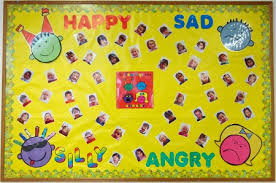
Emotion Board
           There are several elements that I would include in my own Family Child Care Home.  In the media segment, Adriana Castillo shared her own home child care.  One thing from the media segment that I would like to include in my own home child care would be the welcome area.  In Adriana’s welcome area, she included a sign in book for the families to provide information about their child for that day as well as a poster of each of the families with whom she worked (Laureate Education, 2011).  This welcome area would allow the early childcare provider to have a record of important details about each specific child as well as allowing each child to recognize him or herself as a part of the center.  One adjustment I might include in my own personal center would be to create another poster or bulletin board, in the welcome area, where the child would have to answer a simple question pertaining to our curricular area.  For example, in Adriana’s center, they were studying about emotions.  I would create a bulletin board with a variety of emotions and attach each child’s picture on a magnet or Velcro.  They could then move their picture to show how they were feeling that particular day.  The welcome area not only served as a place where the families could share, but also as a place where they could see themselves in their environment (Derman-Sparks and Edwards, 2010).

 
                Another aspect that Adriana included in her environment was a “rest area” (Laureate Education, 2011).  This was a place that was comfortable and allowed the children to adjust to their daycare environment.  Adriana Castillo shared that many of the children experienced separation anxiety (Laureate Education, 2011) and this rest area provided them some comfort while they were experiencing the emotions of leaving their parent.
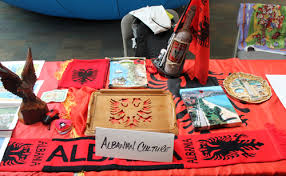
 
Culture Share
               As far as anti-bias elements, Adriana Castillo provided many materials that contributed to an anti-bias environment.  One element that I would place in my own home child care would be the family culture share area.  I thought this was another wonderful way for the children to see themselves reflected in their environment while learning about the cultural diversity of their peers.
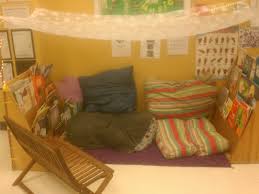
Cozy Reading Area
                In my free play area, I would be sure to provide an assortment of anti-bias materials.  I would include an library area with comfortable seating and lighting where the children could read.  Derman-Sparks and Edwards (2010) described the importance of including a variety of diverse books that represented not only cultures of children in the center, but also of the greater society.  I would work to build a classroom library of books that represented these things as well as books that portrayed stereotypes and bias to use as a teaching tool.
Music Center

                I would also incorporate a music and movement corner of the center where children could explore a variety of instruments and sounds from different cultures.  In order to represent each child’s home culture, I would ask each family to provide or recommend music to place in our music center.  I would also find video representing dances and movement to a variety of music for the children to enjoy.  Using technology, such as the popular game, Just Dance Kids, may also be something I would incorporate here. 

                 
Dramatic Play Area
                 Another area I would want to include would be a dramatic play area.  In this area, I would include clothing representative of my children’s cultures as well as materials such as scarves and cloth for the children to create their own unique style of dress.  In this area I would also ask families to donate empty food containers from their home to represent a variety of different foods that are eaten.  I would also include dolls with various skin, hair and eye colors as well as different physical abilities to reflect various racial and ethnic backgrounds.  I thought the skin colored bean bags from the media segment were a wonderful idea that could aid in anti-bias learning but could also serve many other purposes.  

                 I would also use the idea presented in both the media segment and the course text about decorating the classroom with photographs of the children and their community.  This would serve as another way to represent our community diversity while allowing the children to develop a sense of comfort in the classroom. 

               Overall, I feel that the most important aspect of the childcare center is that each child feels that his or her culture and family is being represented equally and that each child feels safe and comfortable in the setting.  In the media segment Adriana mentioned that she is still learning and changing although she has been practicing early childcare at her setting for four years (Laureate Education, 2011).  This is a very important point as we continue to learn and grow as early childhood educators.    

Resources

Derman-Sparks,L., & Olsen-Edwards, J. (2010). Anti-bias education for young children and
ourselves. National Association for the Education of Young Children. WashingtonD.C.

(NAEYC).
Welcome to an anti-bias learning community ( Laureate Education, 2011). Retrieved from
     _419753. course media.


Monday, October 21, 2013

What I Have Learned


One hope that I have when thinking about working with children and families is to expose them to all of the wonderful diversity that is in our world.  I would hope to help the children and their families develop a deeper understanding of differences and to have an acceptance for all people.

One goal I would like to set for the early childhood field related to diversity, equity, and social justice would be to provide early childhood educators with opportunities to continue their education about these topics.  I have realized that through this course, I still have a great deal to learn about myself as well as how to address issues related to diversity, equity and social justice.  Continuing conversations as well as the learning of early childhood educators would be extremely beneficial to the field.  

I would like to thank all of my colleagues and Dr. Klein for their support and guidance through this course.  I appreciate all of the personal stories that were told, they truly helped deepen my understanding of the topics we studied.  Best of luck in your future courses and work in the early childhood field. 

Friday, October 11, 2013

Start Seeing Diversity..."We Don't Say Those Words in Class"

A few years ago, when my daughter was around 2 years old, we were shopping together in the local Wal-Mart.  While we were walking down one of the aisles, we passed a woman who was bald.  My daughter said, "Mommy, that lady doesn't have any hair!"  I felt immediate embarrassment and quietly shushed my daughter so the woman wouldn't hear my daughter's comments.  I quickly pushed the cart to another aisle and my daughter continued to ask questions like, "is she a boy?"  I told her that we aren't supposed to say things like that out loud. 

By shushing my daughter and telling her that we don't talk about things like that, I was sending a message that the questions she was asking were wrong.  I was teaching her that the differences in people were something to be ashamed of or hidden.  I was also stifling her natural curiosity to ask questions about differences as well as providing her with an opportunity to learn about human differences. 

An anti-bias educator may have responded by saying, "Many people have different hair styles.  They can have long hair, short hair, no hair, hair of many different colors, etc."   A conversation could also take place about reasons people may have no hair, such as disease.   After the initial discussion, we could look at different hair styles that we see on television, in books, in our family as well as in magazines and photographs.  An anti-bias educator would support and develop a child's understanding instead of silencing the child. 

Friday, September 20, 2013

Start Seeing Diversity


I think that society creates an environment of homophobia and heterosexism.  Gender stereotypes pay a large role in this specifically when many activities are defined as specifically for boys or girls.  If a boy or girl engages in a certain activity that is defined for the opposite gender, they can be described as a “tom boy” or a “sissy”. 


As I think about the books that I read with my children or the movies and television shows that they watch, I cannot identify a time when we have read about or watched a story that involved a gay family or couple.  It is almost like this topic is not allowed for young children.  Some of the books that I read with my children include a single parent, but never a situation with a homosexual couple.  Because children do not have much experience with this, it is something they are curious about when they see it. 


My daughter attended a daycare with two little girls who had lesbian parents.  One day, she told me that they did not have a daddy, but two mommies.  I began to explain to her that this is a typical situation.  In fact, she has two daddies, her step-father and her birth father.  She was not satisfied with this explanation and I told her that sometimes two women can love each other and sometimes two men can love each other.  She asked me several questions, but was most concerned about what the couples would wear when they got married!  She was very accepting of the fact that families can be different and I’m very glad she got to experience that at such a young age.   


I feel that early childhood centers should have books and pictures and other resources to help children develop an understanding of different families.  This is a great step toward creating a generation of open-mindedness.  In fact, because my daughter saw this, she was able to ask questions and feel open to the fact that all families are different.


If a parent expressed concerns about having a homosexual caregiver, I would discuss the concern with my colleagues and administrators.  I would hope that we could talk with the parent and offer some diversity trainings or workshops as well as invite the parents into the classroom to see how the child is being cared for.


I have not used a homophobic term toward a child as an insult, but have heard children use homophobic terms toward each other.  I work with a group of 5th grade students.  Last year, there was a boy in another teacher’s class who liked a girl.  The girl did not return his affections and in retaliation, he spread rumors that she was a lesbian.  It was clear that this was meant as an insult and the teacher, administrator and parents had a conference with the child.  These types of comments could influence all children because it creates an environment where these types of comments, meant to insult, become acceptable for others to use.  It can also lead to children who may come from a family that has two moms or dads to feel embarrassed or to develop a negative self identity. 


Gender roles and stereotypes as well as homophobia are topics that need to be discussed and addressed with young children.  It is the lack of exposure and ignorance of the topics that lead children to create stereotypes.